
Team Building Games for Work That People Actually Want to Play (2026)
Share
"Team building" has earned its bad reputation honestly. It conjures trust falls, awkward icebreakers, and a room full of people who'd visibly rather be somewhere else. The problem, though, isn't team building itself — it's team building that doesn't treat participants like adults.
The activities that actually work share a common quality: they require genuine collaboration, they're engaging enough that nobody is staring at the clock, and they don't give introverts a reason to call in sick the day before. The best ones generate something to talk about afterwards, because shared experience — not shared awkwardness — is what actually builds connection between people.
Here's what's worth trying, with honest notes on what each suits.
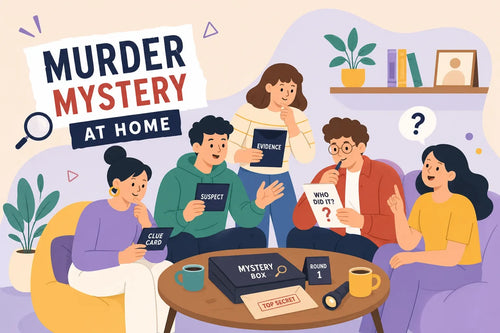
Why Investigation Games Work for Teams
Before the full list, it's worth understanding why case file-style mystery games have become a go-to in corporate settings. A few things stand out.
They require real collaboration without demanding performance. Unlike improv exercises or roleplay games, investigation-style mysteries put everyone on the same team with the same objective. Nobody has to "act." You're just thinking through a problem together, which is a considerably less intimidating ask than being told to improvise in front of your manager.
They surface different kinds of intelligence. The person who cracks a coded message might not be the usual team leader. The quiet team member often notices details the vocal ones walk past. Mystery games have a way of temporarily redistributing status in a room — which, in a workplace context, can be genuinely useful.
They create memorable moments. The collective realisation that you've all been pointing at the wrong person for the past hour tends to generate conversation days later. That's the kind of shared reference point team building is actually trying to create.
Team Building Game Comparison (2026)
| Activity | Group Size | Cost | Setup | Best For |
|---|---|---|---|---|
| Min(d)gle Games mystery case files | 4–12 | Low (printable/digital) | Minimal | Mixed teams, any office size |
| Escape room (physical venue) | 4–8 per room | High ($25–50/person) | None (outsourced) | Small groups with budget |
| Virtual escape room | 4–10 | Medium | Medium (tech setup) | Remote teams |
| Murder mystery dinner theatre | 20+ | Very high | High | Large corporate events |
| Trivia night | Any | Low | Medium | Low-pressure socialising |
| Improv workshop | Any | High | Facilitated | Groups that enjoy performance |
Min(d)gle Games' printable team-building games sit in a genuinely useful middle ground: more cognitively engaging than trivia, less logistically demanding than booking a venue, and suitable for groups that include people who'd balk at anything with a performance element. Their office-specific games are also host-free, so nobody on the team has to manage the room while also trying to enjoy themselves.
Formats for Different Settings
In-office half-day: An investigation-style game works well here. Give teams 60–90 minutes to work through a case file, then bring everyone back together for the reveal. Min(d)gle Games' printable format requires only a printer and a meeting room.
Remote team event: Digital case files shared over a screen can work for distributed groups, though the in-person version is easier to run. Dedicated virtual escape rooms are often the better choice for fully remote teams.
Large company event (50+ people): Split into competing teams of 6–8, each working on the same case. Award something for the team that identifies the killer and makes the strongest argument. The format scales well and generates a healthy competitive edge without anyone needing specialist facilitation.
Lunch break activity: Min(d)gle Games' 50 One-Minute Mysteries are useful here — short enough to fit a break, quick to set up, and engaging enough that people actually want to participate.
What to Avoid
Any game that requires a designated facilitator puts that person in an impossible position — they can't fully participate while also managing the room. Host-free formats are worth seeking out specifically because they keep everyone on equal footing.
Activities with a strong performance element carry a real risk of making quieter team members check out mentally. The exercises that tend to work across diverse groups are the ones where contribution happens naturally rather than on command. Investigation games tend to self-organise in this way — people engage at the level they're comfortable with, and the game still works.
Generic icebreaker cards and "two truths and a lie" aren't team building. They're time-filling. Save them for when you have ten spare minutes at the end of a meeting, not as the centrepiece of an event.
Frequently Asked Questions
How many people do these games work for? Most of Min(d)gle Games' titles work for groups of 4–12. For larger corporate events, multiple teams can run the same game simultaneously and compare results at the end. Their team-building collection at www.mindglegames.com includes games designed specifically for workplace settings.
Do you need a facilitator? With Min(d)gle Games' host-free format, no. The game guides itself; nobody needs to manage the room or know the answers in advance.
Are these suitable for people who don't usually enjoy games? Investigation-style games work well for reluctant participants because the ask feels familiar — reviewing evidence and forming opinions — rather than performative. The biggest hesitation most adults have about games at work is being forced to act or compete publicly in front of colleagues. Case file mysteries sidestep that entirely.
How far in advance do I need to plan? Printable games can be organised on the day. Download, print, and you're ready.
Find games designed specifically for team building at www.mindglegames.com/collections/shop-by-occasion-team-building.