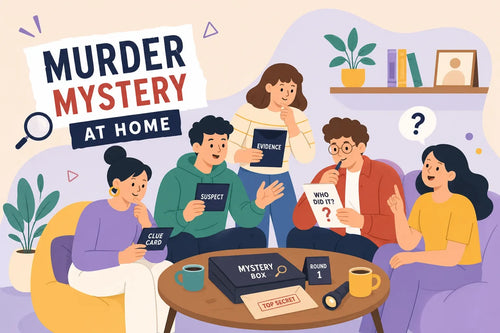

How to run a host-free murder mystery game at home
Share
Choose the right type of mystery
Choose a role-playing mystery when your guests want assigned characters and one person is happy to host the game.
Choose a host-free case file when everyone wants to investigate together. Host-free cases work particularly well for solo players, couples and groups of up to four.
Choose the right format: This guide is for host-free case-file games where everyone investiga
The modern version is considerably simpler. Here's how to run one without turning it into a week-long project.
Step 1: Choose the right format
There are two fundamentally different types of murder mystery game, and they suit genuinely different groups. Choosing the wrong one is the most common mistake first-time hosts make.
Script-based roleplay games assign each guest a character and a script. One person hosts, while everyone else plays suspects with alibis to defend. These work well for theatrical groups that enjoy improvising and performing.
Host-free investigation games give everyone the same role: detective. The group works through the evidence together, nobody needs to know the answer in advance, and every player can take part in the final theory.
Step 2: Match the game to your group size
- One to four players: Choose a case-file or detective game built around deduction.
- Five to eight players: Either format can work. Base the choice on whether the group wants to perform or investigate.
- Nine or more players: Choose a game designed for a larger cast or split into investigation teams.
Step 3: Check the runtime and difficulty
A 45 to 75 minute case suits a weeknight or first attempt. A 60 to 90 minute investigation gives the group more evidence and room to debate. Check the recommended age and difficulty before downloading the files.
If the group is new to case-file games, choose an easier mystery with a clear objective. Experienced players may prefer a case with several timelines, conflicting statements and digital evidence.
Step 4: Decide whether to print or use screens
Most host-free games can be printed or opened on a laptop or tablet. Printing makes it easy to spread evidence across a table, while screens save paper and let players zoom into photographs.
Download the files before the group arrives. Open every link, charge the devices and print any pages that are easier to annotate. Keep the solution closed until everyone has submitted a final theory.
Step 5: Set up the investigation
Place the case introduction and objectives where everyone can see them. Keep witness statements, photographs and other evidence together so players can compare details without waiting for turns.
You do not need costumes or themed decorations unless the group wants them. Good lighting, enough table space and a few pens matter more.
Step 6: Read, sort and question the evidence
Start with the case briefing, then let each player take a document or evidence type. Share every useful detail with the group and create a simple timeline as you go.
When two clues conflict, record both versions. Many mysteries turn on a small difference in timing, wording or access rather than a single dramatic clue.
Step 7: Submit a complete theory
Before opening the solution, agree on the killer, method and motive. Write down the evidence that supports each part of the theory so the group cannot change its answer during the reveal.
Read the solution together and return to the clues it references. The best final reveals explain how the evidence fits together, including the red herrings.
A simple host-free setup checklist
- Choose a case that fits the player count and available time.
- Download the files and test every link.
- Print the evidence or charge the devices.
- Prepare paper and pens for notes and timelines.
- Keep the solution closed until the final answer is ready.
Which case should you start with?
The Disconnect is a free 45 to 75 minute introduction for one to four investigators. Post // Mortem is a longer 60 to 90 minute case. Sleuth Nights contains three standalone mysteries for groups that want several sessions.
tes together. Planning a role-playing mystery with assigned characters and a dedicated host? Read how to host a murder mystery party.
Hosting a murder mystery party has a reputation for being a production. There are scripts to print, characters to assign, costumes to coordinate, and an entire evening to keep from quietly falling apart. That reputation is mostly undeserved, and it traces back to old-school games that required a designated host to hold all the answers while everyone else played the suspects.