
Murder Mystery vs Escape Room: What's the Difference?
Share
You've got a group coming over this weekend. Someone in the group chat says "let's do a murder mystery!" and someone else fires back "what about an escape room?", which raises a fair question: what is the difference between a murder mystery and an escape room game? Now you're deep in a comparison you didn't plan to make, trying to decide between two things that both sound like "fun puzzle games" but work very differently under the hood. Choosing the wrong format doesn't just waste money. It can drain the energy out of the whole evening before the first clue hits the table.
At Min(d)gle Games, we publish both formats, and we hear this exact question from nearly every group we work with. The good news: once you understand how each one actually works, the right choice becomes obvious. This article walks through the real differences in mechanics, pacing, player roles, setup effort, and group fit so you can pick with confidence and get to the fun part faster.
Murder mystery vs. escape room game: how each format works at its core
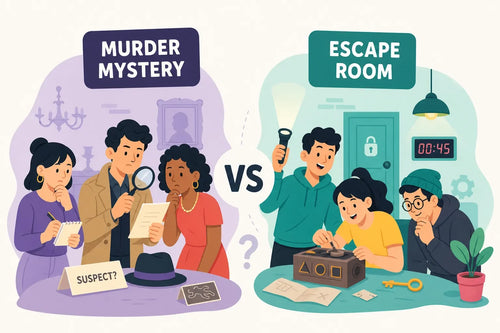
The foundational difference between these two formats is not the theme, the mood, or even the difficulty. It's the actual game engine underneath. One runs on social deduction and character play. The other runs on timed puzzle-solving and locked progression. Get that distinction clear first, and everything else falls into place.
Murder mystery runs on roles, shared information, and accusation
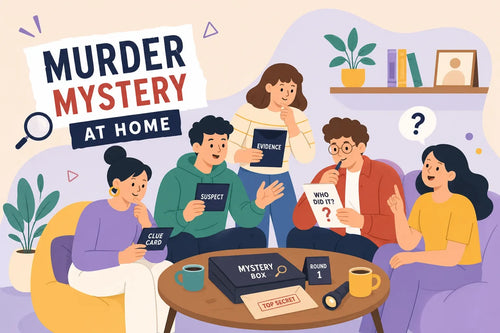
Every player steps into a character with a backstory, a motive, and secrets they may or may not choose to reveal. The mechanic driving this interactive murder mystery format is information asymmetry: each person knows something different, and the group has to trade, interrogate, and cross-reference until someone can make a confident accusation. There are no locks to crack. The puzzle is each other. Progress is measured in conversations, not keys, and the experience rewards people who enjoy reading a room and building a case piece by piece.
Escape room runs on timed puzzle chains and locked progression
Players enter a themed space, physical or digital, with a countdown already running. The core mechanic of this immersive puzzle game format is sequential unlocking: solve a puzzle, get a code, open a lock, find the next clue. Progress is visible and mechanical. Nobody needs to roleplay or share information strategically. The group just needs to think fast, divide tasks efficiently, and get out before the clock hits zero. The urgency is the whole point.
Setup requirements and the host's role in each format
These two formats sit at opposite ends of the prep spectrum, and that gap directly affects who can realistically run them. For many groups, the amount of setup involved is the deciding factor before they ever think about mechanics or theme.
Murder mystery party planning: facilitation and advance preparation
A host running a traditional murder mystery party typically starts two to four weeks out. That means sending invitations, assigning characters, and distributing materials so players can get familiar with their roles before the event. On the day itself, they set the scene, brief players on the rules, manage clue drops, and run the reveal sequence. It's a rewarding role, but it is a role. That said, players who want a fully host-free experience can use case file-style games where the facilitation is built directly into the printed materials, removing that barrier entirely and letting the game run itself.
Escape room party experiences are largely self-contained
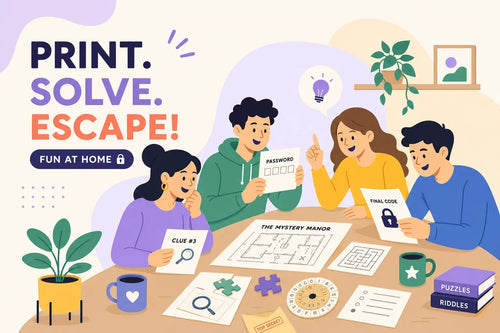
Whether you're booking a venue or downloading a printable escape room kit, the puzzle environment is pre-built. A commercial venue handles the physical setup and stations a game master nearby to monitor time and drop hints. A printable escape room works the same way: the puzzle flow is already sequenced, the instructions are clear from the first page, and no one needs to actively manage the game while it's running. This makes escape rooms much easier to hand off to a group with minimal host involvement on the day.
Pacing and how the experience actually feels
This is where the murder mystery vs. escape room game distinction feels most pronounced in practice. The pacing shapes the emotional tone of the entire event, and it's one of the biggest factors in whether a format actually clicks with a specific group of people.
Murder mystery unfolds slowly and rewards conversation
There is no countdown. Players move at a social pace, driven by curiosity and character play rather than urgency. A mystery dinner game can run two to four hours and still feel comfortable because the structure breathes. Extroverts and introverts alike can find their rhythm, though the format rewards people who enjoy talking, reading body language, and building a case methodically over time. The emotional payoff comes at the reveal, not from beating a clock.
Escape room creates urgency through time pressure
The 60-minute countdown is more than a rule; it is the core emotional engine. The ticking clock creates adrenaline, and the game is intentionally designed to build intensity as time shrinks. Teams feel the pressure and have to make fast decisions under stress. This is thrilling for groups who love competitive problem-solving, but it can feel punishing for groups who prefer a relaxed social pace or who struggle when performance is on the line.
Group size, cost, and where you can actually play
Practicalities matter as much as mechanics. These two formats have different constraints when it comes to headcount, budget, and venue flexibility, and knowing the numbers upfront saves a lot of planning headaches.
Escape rooms cap out at 6 to 8 players and typically cost $25 to $45 per person
Most commercial escape rooms are designed for four to six players, with some venues allowing up to eight to twelve in larger rooms. The experience degrades when too many people share a small space with not enough puzzles to keep everyone engaged. Pricing at commercial venues typically runs between $25 and $45 per person. Add briefing and debriefing, and your 60-minute game becomes a 90-minute outing, minimum.
Murder mystery scales for larger groups and plays anywhere
A well-designed murder mystery can accommodate anywhere from six players to 20 or more, depending on the format. Because the game happens in conversation rather than inside a locked room, it works in a living room, backyard, office conference room, or over a video call. The cost is usually a flat fee for a kit rather than a per-person venue charge, which makes it significantly more budget-friendly as headcount grows. For groups of 10 or more, the cost difference becomes dramatic very quickly.
Which format fits your event?
Matching a format to a specific event comes down to group size, the emotional experience you want to create, and how much logistics you're willing to manage. Here's how the difference between a murder mystery and an escape room game plays out across common event types:
- Corporate team-building and large gatherings: Murder mystery is the stronger choice. It keeps everyone in the same shared experience, encourages cross-group conversation, and accommodates mixed comfort levels with puzzles. An escape room party works better for tighter teams of four to six who want a competitive, high-energy challenge.
- Date nights and small groups: Escape rooms shine here. The focused puzzle format keeps two to four people fully occupied from the first minute. A printable escape room at home delivers the same urgency and satisfaction without the venue booking.
- Virtual events: Murder mystery translates better for larger or mixed groups online because the social-deduction format holds up over a video call without requiring physical objects. A screen-compatible escape room can work for small virtual teams if the puzzle design is built for it.
Try both formats at home without any venue logistics
Here's the practical upside for anyone still on the fence: you don't have to choose blindly, and you don't have to book a venue to try either format. At Min(d)gle Games, we've built both murder mystery games and escape room games as instant digital downloads. You print them or play them directly on screen, no setup required, no dedicated host needed unless you want one.
Our murder mystery games come in two styles: roleplay formats where every player takes on a character, and host-free case file formats where the facilitation is baked into the printed materials. Our escape room games are puzzle-forward, timed experiences designed specifically for home play, with the puzzle flow and instructions already sequenced so any group can pick up and start immediately. Both formats are screen-compatible and ready the moment you download them.
Not sure which one your group will love? Pick mystery if they like to talk, debate, and play characters. Pick escape room if they thrive under pressure and love cracking codes fast. Either way, you have both options in one place, at a fraction of what a commercial venue costs, and without any of the usual planning headaches.
The right game for the right group
If you're still weighing what is the difference between a murder mystery and an escape room game, here's the short answer: murder mystery games are social, character-driven, and conversation-powered, while escape room games are timed, puzzle-driven, and built around sequential unlocking. Both are solid formats. Neither is objectively better. They just fit different groups and different moments.
The real question is your group's personality. Do they love talking, debating, and playing characters over a long dinner? Go mystery. Do they want a high-energy puzzle sprint with a countdown creating real pressure? Go escape room. Think about your group first, and let the format follow from there.
When you're ready to run either one at home, Min(d)gle Games has you covered with both formats available as instant downloads, built for real groups and real evenings, and guaranteed to give your guests something to talk about long after the night ends.